
AI Agency Business Model
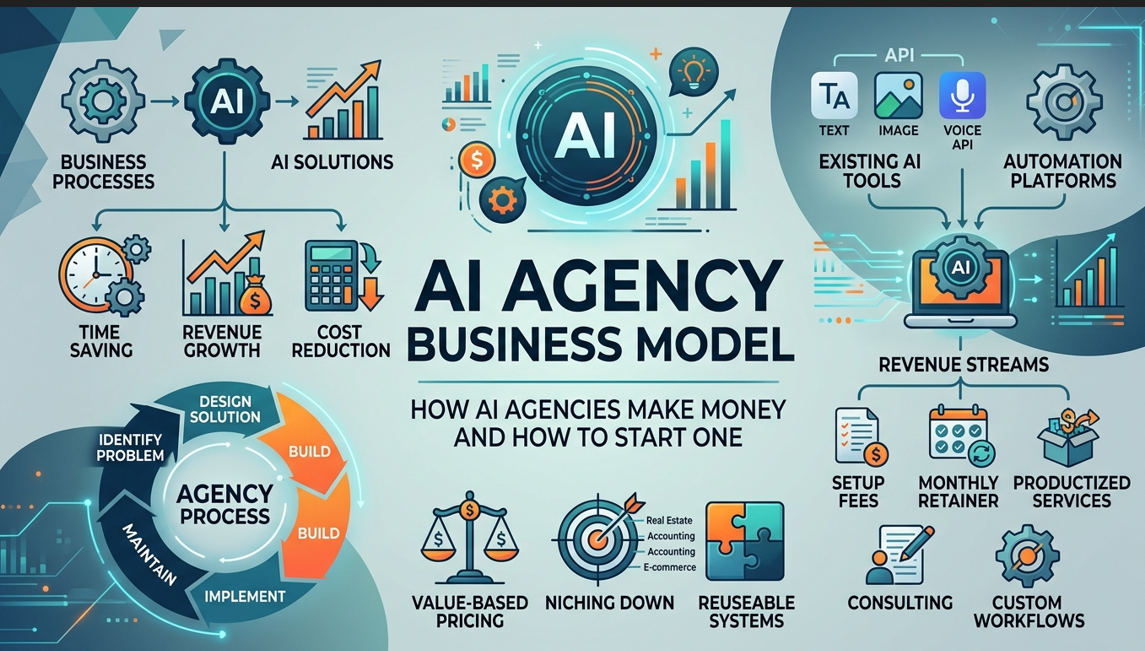
AI Agency Business Model: How AI Agencies Make Money and How to Start One
The AI agency business model is becoming an attractive way to build a service business without creating your own AI software.
Instead of developing a new AI model, an AI agency uses existing tools to help businesses automate tasks, create content, improve customer service, analyze information, or save employees time.
The agency charges the client for setting up and managing these solutions.
This sounds simple, but there is an important difference between an AI agency that makes money and one that struggles.
The successful agency is not really selling “AI.”
It is selling a business result.
For example, a client may not care that you built an AI chatbot using three different tools. They care that the chatbot answers customer questions automatically and reduces the number of calls their employees have to handle.
That is the foundation of the AI agency business model.
What Is an AI Agency Business Model?
An AI agency is a service business that helps companies use artificial intelligence to solve specific business problems.
The agency usually combines existing AI tools, automation platforms, software, and human expertise to create a solution for a client.
A typical process looks like this:
Find a business problem → design an AI solution → build it → implement it → maintain it → charge the client
For example, an accounting firm might receive hundreds of documents from clients.
An AI agency could build a system that:
- receives documents,
- extracts important information,
- categorizes files,
- identifies missing information,
- sends notifications,
- stores the information in the appropriate system,
- and alerts an employee when human review is required.
The accounting firm doesn’t need to know how the system works behind the scenes.
It simply wants the process to become faster and easier.
How Does an AI Agency Make Money?
There are several ways an AI agency can generate revenue.
The most common model combines setup fees with recurring monthly fees.
For example:
Initial setup: $2,000
Monthly management: $500
If you have 10 clients paying $500 per month, that creates:
$5,000 in recurring monthly revenue.
The agency can then charge additional fees for new projects.
A simple AI agency revenue model might look like this:
| Revenue source | Example |
|---|---|
| AI automation setup | $1,000–$5,000+ |
| AI chatbot setup | $1,000–$5,000+ |
| Monthly maintenance | $200–$2,000+ |
| AI content services | $500–$3,000/month |
| Consulting | $100–$500+/hour |
| Custom AI workflows | $2,000–$10,000+ |
| Training | $500–$5,000+ |
These are example ranges rather than fixed market prices. Your pricing should depend on the client’s size, the complexity of the project, the value created, and your level of support.
The Three Main AI Agency Business Models
There isn’t just one way to operate an AI agency.
There are several models you can choose from.
1. AI Automation Agency
This model focuses on automating repetitive business processes.
For example:
Customer sends inquiry → AI reads inquiry → information is extracted → CRM is updated → salesperson receives notification → customer receives a response.
Tools such as automation platforms, AI models, CRMs and business applications can be connected to create these workflows.
You might automate:
- lead qualification
- appointment booking
- email processing
- customer support
- document processing
- data entry
- reporting
- invoice processing
- follow-up messages
- internal notifications
This is one of the easiest AI agency models to explain to potential clients because the benefit can be measured in time saved.
2. AI Content Agency
An AI content agency uses AI to help businesses produce content faster.
Services could include:
- blog articles
- social media posts
- product descriptions
- newsletters
- video scripts
- email campaigns
- SEO content
- advertisements
- video repurposing
However, simply offering “AI-written articles” is becoming increasingly difficult to differentiate.
A better approach is to sell a complete outcome.
Instead of:
“We use AI to write blog posts.”
Offer:
“We help local businesses publish SEO content every week without hiring an in-house content team.”
The second offer is focused on the client’s problem rather than the technology.
3. AI Chatbot Agency
Another model is building AI-powered customer-service and sales assistants.
A business might have thousands of questions coming through its website.
An AI assistant can potentially answer common questions, collect customer information and direct complex cases to employees.
For example:
Website visitor → asks question → AI answers → collects contact details → qualifies lead → sends lead to CRM → sales representative follows up.
You could charge for:
- initial chatbot setup
- knowledge-base integration
- website installation
- monthly maintenance
- analytics
- improvements
- ongoing monitoring
The key is to avoid positioning the chatbot as simply a novelty.
The better pitch is:
“We help your website convert more visitors into qualified leads.”
4. AI Consulting Agency
You don’t necessarily have to build complicated systems.
You can also sell AI consulting.
A company may know that AI could help its business but have no idea where to start.
You can analyze its processes and identify opportunities.
For example:
Business process audit → identify repetitive tasks → estimate potential savings → recommend AI solutions → create implementation plan.
You can charge for the assessment itself and then offer implementation services.
This can also become a gateway to larger projects.
The Best AI Agency Model: Productized Services
One of the most interesting approaches is the productized AI service.
Instead of telling clients:
“We can build anything you want.”
You create one specific service with a defined outcome.
For example:
AI Lead Follow-Up System
Setup: $1,500
Monthly management: $300
Includes:
- lead capture
- automatic qualification
- AI-generated responses
- CRM updates
- follow-up reminders
- reporting
Now your sales process becomes much easier.
You’re not selling an undefined AI service.
You’re selling a specific solution.
Why Niching Down Matters
One of the biggest mistakes new AI agencies make is trying to serve everyone.
They say:
“We provide AI solutions for businesses.”
That’s too broad.
A better strategy is:
One industry + one painful problem + one solution.
For example:
AI automation for accounting firms
or:
AI lead follow-up for real estate agencies
or:
AI customer support for online stores
or:
AI document processing for law firms
When you specialize, your marketing becomes much easier.
You can create content specifically for that industry.
Your sales pitch becomes more relevant.
And you can reuse parts of the same system for multiple clients.
Example: AI Agency for Real Estate Companies
Imagine you decide to focus exclusively on real estate agencies.
You discover that agents spend hours responding to inquiries.
You create an AI lead qualification system.
A potential buyer submits:
“I’m looking for a three-bedroom house under $150,000.”
The system can potentially:
- Read the inquiry.
- Identify the buyer’s requirements.
- Ask follow-up questions.
- Categorize the lead.
- Add the information to the CRM.
- Notify the appropriate agent.
- Send relevant property information.
- Schedule a follow-up.
You could package this as:
AI Real Estate Lead System
Instead of selling hours of development, you’re selling a business solution.
How Much Should an AI Agency Charge?
There is no universal price.
The right price depends on the value and complexity of the solution.
A useful way to think about pricing is:
Client value > cost of your tools + your labor
Suppose your system costs you $100 per month to operate.
That doesn’t mean you should charge the client $120.
If your solution saves a company 40 hours every month or helps generate additional sales, its business value could be much higher.
For example:
AI system creates $3,000 in estimated monthly value
You might charge:
$1,000 setup + $500/month
The client still receives a positive economic benefit while your agency earns recurring revenue.
Setup Fee vs Monthly Retainer
A strong AI agency often uses both.
Setup fee
The setup fee pays for building and implementing the system.
It can cover:
- discovery
- workflow design
- integrations
- configuration
- testing
- deployment
- training
Monthly fee
The recurring fee pays for ongoing services such as:
- monitoring
- maintenance
- AI usage
- troubleshooting
- improvements
- reporting
- support
This creates predictable recurring revenue.
Instead of constantly searching for new clients just to generate revenue, your existing clients continue paying for ongoing service.
The AI Agency Profit Formula
A simple way to think about the business is:
Revenue – software costs – contractors – operating expenses = profit
For example, imagine an agency has:
15 clients × $600/month = $9,000/month
Suppose its monthly operating costs are:
- AI tools: $700
- automation software: $300
- hosting: $200
- contractors: $1,500
- miscellaneous costs: $300
Total expenses:
$3,000
That leaves approximately:
$6,000 before taxes and other business expenses.
The numbers are only an example, but they demonstrate why recurring services can be attractive.
Do You Need to Build Your Own AI?
No.
This is one of the biggest misconceptions about starting an AI agency.
You don’t necessarily need to train an AI model.
You can combine existing technologies.
For example:
AI model + automation platform + CRM + database + business application
can become a useful business system.
Your value comes from understanding the client’s workflow and connecting the right technologies.
Think of yourself as the architect of the solution.
The Tools an AI Agency Might Use
Your technology stack will depend on the service you sell.
An agency might use:
- AI language models
- image-generation tools
- transcription tools
- automation platforms
- CRM systems
- databases
- website platforms
- analytics tools
- email platforms
- document-processing systems
You don’t need 50 different tools.
In fact, having too many tools can make your business harder to manage.
A better strategy is to become very good with a small number of tools.
For example:
One AI platform + one automation platform + one CRM + one database
can be enough to build many useful solutions.
How to Start an AI Agency
You don’t need to begin with a large team.
A simple starting process is:
Step 1: Choose an industry
Pick an industry where businesses have repetitive processes and the ability to pay for solutions.
Examples include:
- accounting
- real estate
- law
- healthcare administration
- e-commerce
- marketing
- education
- logistics
- professional services
Step 2: Find a painful problem
Don’t start by asking:
“What can AI do?”
Ask:
“What task is costing this business too much time or money?”
That question produces better opportunities.
Step 3: Build a demonstration
Create a small working example.
You don’t need a complete enterprise system.
A simple demonstration can show the client what is possible.
Step 4: Create a fixed offer
Turn the solution into a productized service.
Give it:
- a name
- a clear result
- a setup price
- a monthly price
- defined deliverables
Step 5: Find potential clients
You can use:
- business directories
- networking
- referrals
- local businesses
- industry communities
- partnerships
Step 6: Sell the result
Don’t lead with technical terminology.
Explain:
problem → solution → expected benefit → price
How to Get Your First AI Agency Client
Your first client doesn’t have to be a large corporation.
A small business can be a good starting point.
Look for companies where you can clearly identify a repetitive problem.
For example, you notice that a business takes several hours every day to answer repetitive customer inquiries.
Instead of saying:
“I run an AI automation agency.”
Try:
“I noticed your team receives a large number of repetitive inquiries. I built a system that can automatically handle common questions and send qualified requests to your staff.”
That is a much stronger conversation.
Don’t Sell AI. Sell Time, Revenue or Cost Savings.
This is probably the most important principle in the entire AI agency business model.
Businesses don’t buy AI because it is interesting.
They buy solutions because they want to:
make more money
save money
save time
serve customers faster
reduce repetitive work
increase productivity
avoid hiring for tasks that can be automated
Therefore, your offer should be connected to one of these outcomes.
Instead of:
“AI-powered email automation.”
Say:
“Automatically respond to new leads within minutes and notify your sales team when a lead is ready.”
The second statement is easier for a business owner to understand.
AI Agency vs Traditional Agency
The business model looks similar to a traditional service agency, but AI can change how the work is delivered.
| Traditional agency | AI agency |
|---|---|
| More manual work | More automation |
| More employees needed as clients grow | Potentially more scalable |
| Hourly/project-based services | Productized and recurring services |
| Manual reporting | Automated reporting |
| Manual content production | AI-assisted production |
| Manual customer responses | AI-assisted responses |
AI doesn’t eliminate the need for people.
Instead, it can allow a small team to deliver more work.
What Makes an AI Agency Scalable?
A major advantage comes from reusing systems.
Imagine you build an AI lead qualification system for one real estate company.
The first implementation might take 40 hours.
But after building the system, you understand the process.
For the next client, perhaps only certain parts need customization.
You can reuse:
- workflow templates
- prompts
- automation structures
- onboarding documents
- reporting dashboards
- training materials
- SOPs
This is where an agency can become more profitable.
Instead of reinventing everything for every client, you create a repeatable system.
Common AI Agency Mistakes
Mistake 1: Offering Everything
Don’t become:
“We do AI chatbots, websites, SEO, video, automation, apps, consulting and everything else.”
It makes your agency difficult to understand.
Start narrow.
Mistake 2: Charging Only by the Hour
Hourly billing can limit your upside.
Where appropriate, package your services around outcomes and value.
Mistake 3: Using Too Many Tools
More tools don’t automatically create better solutions.
Keep your technology stack manageable.
Mistake 4: Ignoring Human Review
AI can make mistakes.
Important workflows may require human approval, especially when the consequences of an incorrect answer are significant.
Mistake 5: Selling Technology Instead of Results
The client doesn’t necessarily care whether you used one AI model or another.
They care about what the system does for their business.
Is an AI Agency a Good Business Model?
It can be, particularly for someone who understands both business problems and AI tools.
The biggest opportunity isn’t necessarily creating a revolutionary AI product.
It can be much simpler:
Find an expensive repetitive task → automate part of it → package the solution → charge for implementation and ongoing support.
That model can be started relatively small and expanded as you gain clients.
However, competition is increasing.
Simply calling yourself an “AI agency” isn’t enough anymore.
Your advantage should come from specialization, implementation ability, customer service and measurable results.
A Simple AI Agency Business Model You Can Copy
Here’s one example:
Target market
Accounting firms
Problem
Employees spend too much time processing incoming documents.
Solution
AI document-processing and classification workflow.
Setup fee
$2,500
Monthly fee
$500
Service includes
- document intake
- AI classification
- information extraction
- workflow automation
- human review
- notifications
- maintenance
- monthly reporting
Goal
Reduce repetitive document-processing work.
Now you have a real business offer.
You’re no longer simply saying:
“I provide AI services.”
You’re saying:
“I help accounting firms reduce the manual work involved in processing client documents.”
That is a much stronger business proposition.
Final Thoughts
The AI agency business model is essentially a modern version of a service business.
You find a business problem, use AI and automation to create a solution, implement it for the client, and charge for the value you provide.
The most attractive model for many beginners is a combination of:
one niche + one painful problem + one repeatable AI solution + setup fee + monthly recurring revenue.
You don’t need to build your own AI model.
You don’t need a huge team.
And you don’t need dozens of services.
Start with one problem you understand well.
Build one solution.
Get one client.
Document the process.
Then turn what worked into a repeatable service.
That’s how an AI agency can move from a freelance-style business into a scalable service company.