
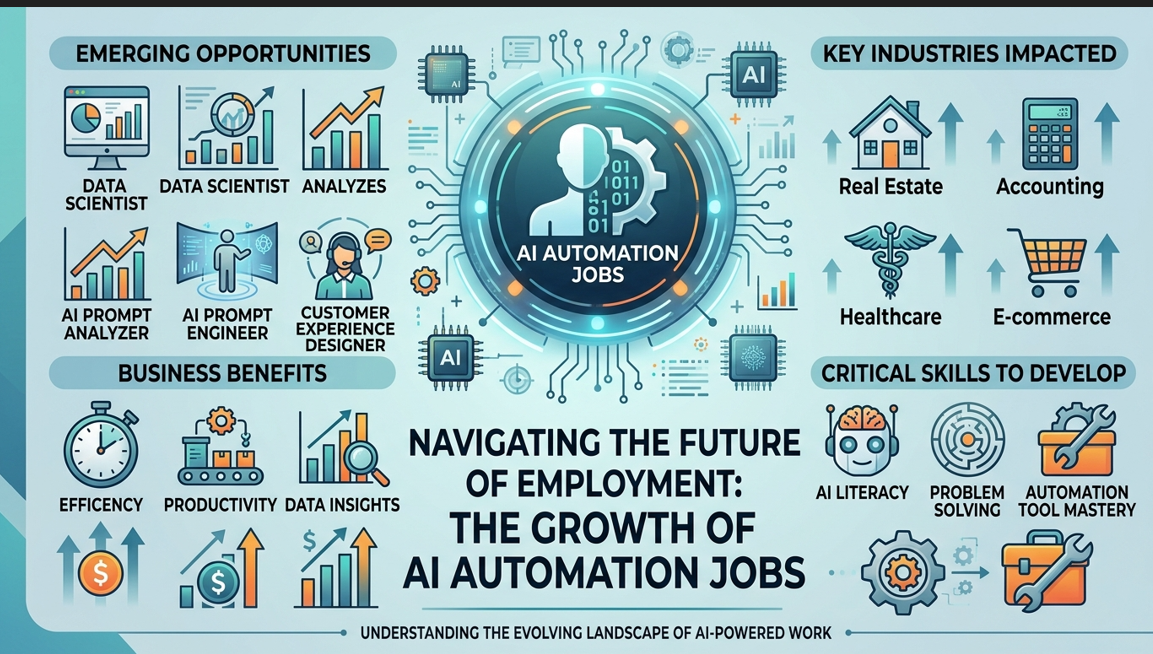
AI Automation Jobs: 10 Careers You Can Start as AI Changes the Workplace
Artificial intelligence is changing the job market, but that does not mean every job is disappearing.
A more interesting shift is happening: businesses need people who can take repetitive work, connect AI tools, and turn manual processes into automated systems.
That is creating a growing category of work around AI automation.
The World Economic Forum’s Future of Jobs Report 2025 lists AI and machine learning specialists, big data specialists, and software developers among the fastest-growing roles through 2030. It also identifies AI and big data as the fastest-growing skill category.
At the same time, the International Labour Organization reported in August 2026 that AI adoption is increasing demand for digital, AI, cognitive and socioemotional skills, while new technical jobs are emerging to develop and maintain AI systems.
So, what exactly are AI automation jobs, and which ones are worth learning?
What Are AI Automation Jobs?
AI automation jobs involve using artificial intelligence and automation software to help businesses perform tasks with less manual work.
For example, instead of an employee:
- Copying customer information into a spreadsheet
- Sending the same follow-up emails
- Reading hundreds of documents
- Answering repetitive customer questions
- Moving information between different applications
- Creating routine reports
an AI automation professional can design a system that handles much of the process automatically.
A simple workflow might look like this:
Customer submits form → AI reads information → system qualifies customer → CRM is updated → personalized email is sent → salesperson receives notification
The person who builds and maintains that workflow is essentially an AI automation professional.
1. AI Automation Specialist
This is probably the most straightforward career to explore if you want to work specifically with AI automation.
An AI automation specialist looks at a company’s repetitive processes and identifies opportunities to automate them.
You might be asked to automate:
- Lead management
- Customer support
- Email follow-ups
- Data entry
- Reporting
- Appointment scheduling
- Document processing
- Internal notifications
- Content workflows
You don’t necessarily need to become a traditional software engineer.
Many business automation systems can be built using visual workflow platforms combined with AI models and APIs.
Skills to learn
Start with:
- Workflow automation
- AI prompting
- APIs
- Webhooks
- CRM systems
- Basic databases
- JSON
- Automation platforms
- AI model integration
The important skill isn’t simply knowing how to use ChatGPT.
It is knowing how to connect AI to a business process.
2. AI Workflow Automation Developer
This role goes a step further.
Instead of simply using existing automation templates, an AI workflow developer builds more complex systems.
For example:
Website → webhook → AI model → database → CRM → email platform → reporting dashboard
A workflow developer may use tools such as automation platforms, APIs, databases and custom code.
You don’t need to master programming immediately.
However, learning some JavaScript or Python can make you considerably more flexible.
What you could build
Imagine an accounting company receives hundreds of invoices.
An automated system could:
- Receive an invoice
- Extract information from the document
- Identify the supplier
- Extract the amount and invoice number
- Categorize the expense
- Send the information to accounting software
- Flag unusual invoices for human review
That is much more valuable than simply asking an AI chatbot to write an email.
3. AI Automation Consultant
An AI automation consultant focuses less on building individual workflows and more on helping companies decide what should be automated.
This can be an attractive career because businesses often know they want AI but don’t know where to begin.
A consultant might examine a company’s operations and identify:
“Your employees are spending 20 hours every week processing these requests. We can automate most of this process.”
The consultant then designs the solution or works with an automation developer to implement it.
Useful skills
You need:
- Business process analysis
- AI knowledge
- Automation knowledge
- Communication
- Project management
- Problem solving
- Basic technical understanding
This is also one of the easiest AI careers to turn into a freelance or agency business.
4. AI Agent Builder
AI agents are becoming another important area of automation.
Instead of creating a workflow where every step is predetermined, an AI agent can be given a goal and access to certain tools.
For example:
Customer asks a question → AI understands request → searches company knowledge → checks customer record → prepares response → escalates complicated cases to a human
AI agent builders design these systems.
They may connect AI models to:
- Databases
- CRMs
- APIs
- Search systems
- Company documents
- Calendar systems
- Business software
This field requires more technical knowledge than basic no-code automation, but it can also lead to more sophisticated projects.
5. AI Customer Support Automation Specialist
Customer service is another major area for automation.
Businesses receive thousands of repetitive questions:
- Where is my order?
- What are your opening hours?
- How much does this service cost?
- How do I reset my password?
- What documents do I need?
- Can I change my appointment?
An AI support system can handle many straightforward requests while sending complicated cases to human employees.
The automation specialist’s job is to design the system, connect it to company information and ensure that customers are not given incorrect answers.
Human oversight remains important, especially when the AI handles sensitive or consequential requests.
6. AI Sales Automation Specialist
Sales teams have plenty of repetitive tasks.
For example:
New lead → research company → identify decision-maker → score lead → update CRM → generate personalized email → schedule follow-up
An AI sales automation specialist can automate much of this process.
The goal isn’t necessarily to replace salespeople.
Instead, automation can allow salespeople to spend more time on conversations and closing deals.
This is particularly useful for companies that receive large numbers of leads but don’t have enough staff to follow up with every prospect manually.
7. AI Marketing Automation Specialist
Marketing is another area where AI automation is being adopted rapidly.
An AI marketing automation professional might create systems for:
- Content research
- Email campaigns
- Social media workflows
- Lead nurturing
- Customer segmentation
- SEO research
- Content repurposing
- Marketing reports
For example:
Blog article published → AI creates social media variations → posts are scheduled → engagement data is collected → weekly report is generated
The human marketer still determines the strategy and reviews important content.
AI simply handles much of the repetitive execution.
8. AI Document Automation Specialist
Businesses deal with enormous amounts of documents.
Think about:
- Invoices
- Contracts
- Receipts
- Applications
- Insurance forms
- Purchase orders
- Reports
- Customer documents
AI can extract information from these documents and send it into other systems.
For example:
PDF invoice → AI extracts data → validates information → accounting system → human approval
This is particularly interesting because document automation can solve very specific business problems.
Someone who learns document processing, OCR, AI extraction and workflow automation can potentially specialize in industries such as accounting, insurance, logistics or legal services.
9. AI Operations Automation Specialist
Operations teams often contain repetitive processes that aren’t obvious from the outside.
Examples include:
- Inventory updates
- Employee onboarding
- Internal requests
- Daily reports
- Data synchronization
- Notifications
- Approvals
- Task assignments
An AI operations automation specialist identifies these bottlenecks and builds systems to reduce manual work.
This role combines business knowledge with technology.
And that combination is becoming increasingly valuable.
PwC’s 2026 AI Jobs Barometer found that skills in highly AI-exposed jobs are changing more than twice as quickly as those in less-exposed jobs, reinforcing the importance of continuously updating skills.
10. AI Automation Agency Owner
You don’t necessarily have to work for an employer.
You can sell AI automation services directly to businesses.
For example, an AI automation agency could offer:
Lead automation
“I’ll automatically capture, qualify and route your leads.”
Customer support automation
“I’ll build an AI assistant that answers common customer questions.”
Document automation
“I’ll automate the extraction of information from your invoices.”
CRM automation
“I’ll connect your website, CRM and email system.”
Reporting automation
“I’ll automatically generate your weekly business reports.”
Instead of charging for hours, you can package these as specific services.
This is sometimes called productized AI automation.
What Skills Do You Need for AI Automation Jobs?
You don’t need to learn everything at once.
A practical learning path looks like this:
Beginner
Learn:
- AI fundamentals
- Prompting
- Workflow concepts
- Automation platforms
- Spreadsheets
- Basic CRM concepts
Intermediate
Add:
- APIs
- Webhooks
- JSON
- Databases
- AI model APIs
- Authentication
- Error handling
Advanced
Learn:
- Python or JavaScript
- AI agents
- RAG systems
- Vector databases
- Advanced API integrations
- Cloud platforms
- Monitoring
- Security
- AI evaluation
The World Economic Forum expects AI and big data, cybersecurity and technological literacy to be among the fastest-growing skills through 2030. But it also highlights creative thinking, resilience, analytical thinking and lifelong learning.
That means becoming good at AI automation is not just about technology.
You also need to understand people and businesses.
Do You Need a Computer Science Degree?
Not necessarily.
For many automation-focused roles, your ability to demonstrate that you can solve real business problems can be more useful than simply having a certificate.
A beginner could build a portfolio containing three or four projects.
For example:
Project 1: AI lead qualification system
Project 2: Automated customer-support assistant
Project 3: Invoice-processing workflow
Project 4: AI content repurposing system
Then document:
- The problem
- The old manual process
- The automated process
- Tools used
- Time saved
- How errors are handled
- Where human approval is required
That gives a potential employer or client something concrete to evaluate.
Are AI Automation Jobs Actually Growing?
The broader employment data suggests that AI-related skills and roles are becoming increasingly important, although the market is not simply creating jobs without disruption.
The World Economic Forum estimates that by 2030, labour-market transformation could create about 170 million jobs while displacing 92 million, producing a net increase of 78 million jobs. AI and information-processing technologies are among the major drivers of that change.
At the same time, some traditional roles are under pressure.
The WEF expects clerical and administrative roles, among others, to experience significant declines as technology changes how work is performed.
This is why learning how to work with automation may be more useful than simply trying to avoid automation.
AI Automation vs Traditional AI Jobs
You don’t have to become an AI researcher to participate in the AI economy.
| Career | Main Focus | Technical Difficulty |
|---|---|---|
| AI Automation Specialist | Business workflows | Beginner–Intermediate |
| AI Workflow Developer | Complex integrations | Intermediate |
| AI Automation Consultant | Business strategy | Intermediate |
| AI Agent Builder | AI agents and tools | Intermediate–Advanced |
| AI Support Specialist | Customer service | Beginner–Intermediate |
| AI Sales Automation | Sales processes | Beginner–Intermediate |
| AI Marketing Automation | Marketing systems | Beginner–Intermediate |
| Document Automation Specialist | Document processing | Intermediate |
| AI Operations Specialist | Internal processes | Intermediate |
| AI Automation Agency Owner | Selling automation services | Intermediate |
How to Get Your First AI Automation Job
Don’t start by trying to learn 50 AI tools.
Instead, pick one business problem.
For example:
“I want to automate lead follow-up for small businesses.”
Then learn the tools required to solve that problem.
Build a working demonstration.
Record a short video showing:
Before automation → automated workflow → result
Put the project into a simple portfolio.
Then approach businesses that have the exact problem you’ve solved.
This is often a better strategy than simply saying:
“I know AI.”
Instead, you can say:
“I built a system that automatically captures leads, qualifies them and sends follow-ups.”
That’s a business outcome.
The Biggest Mistake Beginners Make
The biggest mistake is becoming obsessed with AI tools instead of learning business processes.
There will always be new AI models, automation platforms and software.
Tools change.
The underlying problems don’t.
Businesses will continue to need help with:
- Getting customers
- Serving customers
- Processing information
- Managing employees
- Reducing repetitive work
- Organizing data
- Increasing productivity
- Reducing costs
If you understand those problems, you can learn the tools needed to solve them.
Final Thoughts
AI automation is becoming an important part of the changing job market.
You can approach it as an employee, freelancer, consultant, developer or agency owner.
The strongest opportunity isn’t necessarily:
“How do I learn AI?”
A better question is:
“What expensive or repetitive business problem can I solve using AI and automation?”
That shift in thinking can make your skills much more valuable.
AI is likely to automate parts of many jobs. But people who know how to design, manage, supervise and improve AI-powered workflows may become increasingly valuable.
The key is to start small, build real projects and learn continuously.
As the ILO noted in its 2026 analysis, AI is changing not only which tasks people perform, but also the mix of cognitive, digital and human skills required to perform them.
The future of work may not simply be humans versus AI. In many jobs, it will be people who know how to use AI effectively versus people who don’t.