Can You Sell AI-Generated Art?
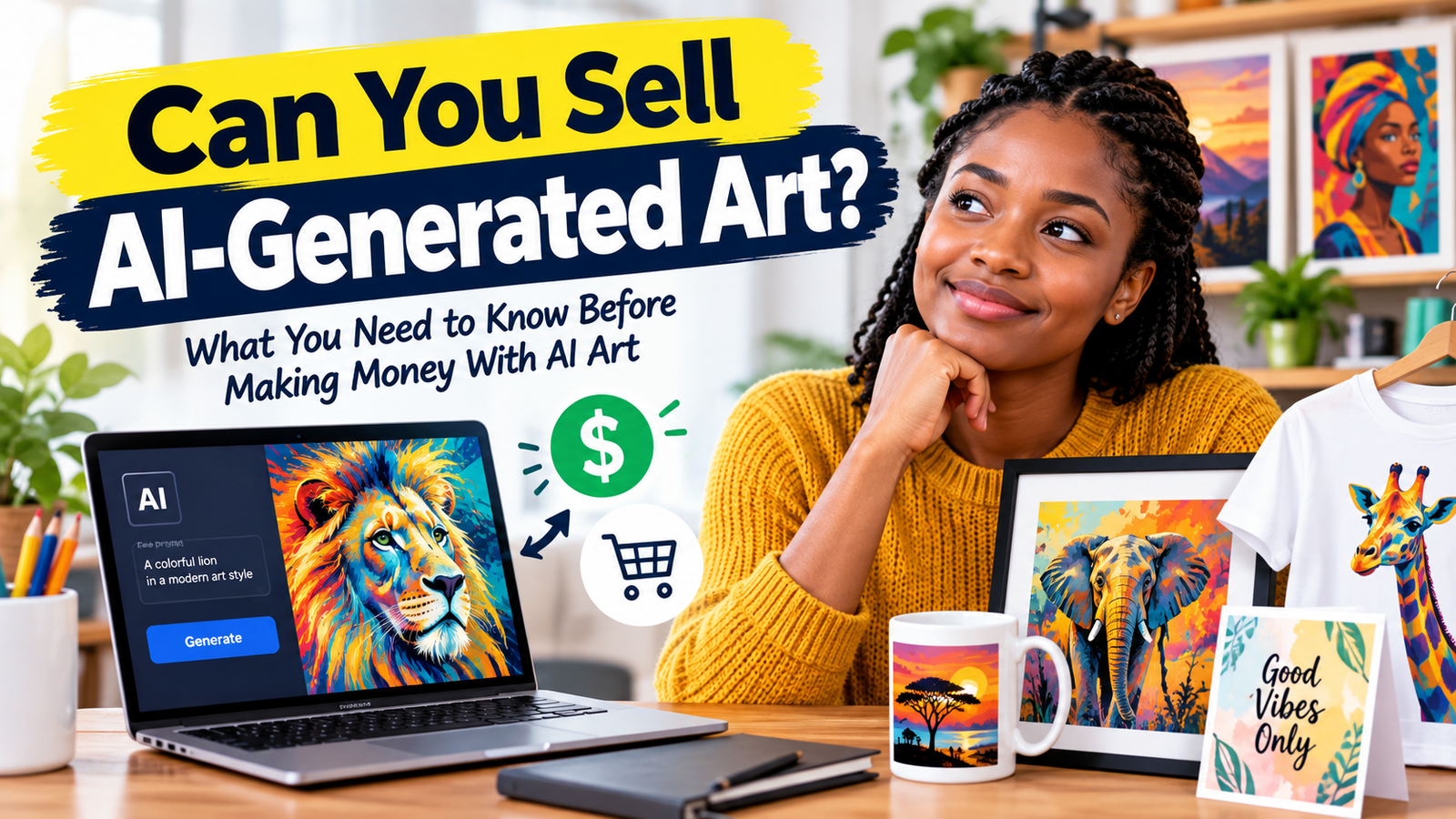
Can You Sell AI-Generated Art? What You Need to Know Before Making Money With AI Art
AI-generated art has made it possible for almost anyone to create illustrations, posters, wall art, characters, greeting cards, book covers, digital prints, and other visual products without being a traditional artist.
But this raises an important question:
Can you actually sell AI-generated art?
The short answer is yes, in many situations—but there are important conditions.
Creating an image with an AI tool does not automatically mean you have unlimited rights to sell it. You need to consider the AI platform’s terms, copyright law, trademarks, other people’s intellectual property, and how much human creativity you contributed to the final work.
The biggest mistake is assuming:
“I generated it with AI, so I automatically own everything.”
That’s not necessarily true.
Can You Sell AI-Generated Art?
Yes. AI-generated artwork can be used commercially in many situations, including selling:
- Digital artwork
- Wall art
- Posters
- T-shirts
- Stickers
- Greeting cards
- Phone cases
- Print-on-demand products
- Book illustrations
- Children’s activity books
- Website graphics
- Social media graphics
- Marketing materials
- Stock-style images
- Customized artwork for clients
However, whether you can sell a particular image depends on several factors.
There are actually two separate questions:
1. Does the AI tool allow commercial use?
And:
2. Do you have sufficient rights in the artwork itself?
Those aren’t always the same thing.
1. Check the AI Tool’s Commercial-Use Terms
Before selling an AI-generated image, check the terms of the platform that created it.
Different AI image generators can have different rules concerning:
- Commercial use
- Ownership
- Copyright
- Free versus paid plans
- Public versus private generations
- Training data
- User inputs
- Generated outputs
Never assume that every AI image generator gives you identical rights.
For example, if you’re using an AI tool to create artwork for a business, don’t simply look at a sentence saying “commercial use allowed.”
Read the relevant terms carefully.
You want to understand what the provider says about ownership and your ability to use the output commercially.
2. Selling AI Art and Owning Copyright Are Different Things
This is one of the most important concepts to understand.
Being allowed to sell an image does not necessarily mean you have strong copyright protection over the image.
The U.S. Copyright Office has taken a particularly important position on this issue.
In its January 2025 report on AI-generated outputs, the U.S. Copyright Office concluded that AI-generated material can receive copyright protection when there is sufficient human creative contribution. It also stated that simply providing prompts to an AI system, by itself, is generally not enough to establish the necessary human authorship.
That creates an important distinction.
Imagine you type:
“A beautiful African sunset over a mountain landscape.”
The AI generates the entire image.
You may be permitted to commercially use the image under the AI service’s terms.
But that doesn’t necessarily mean you can claim strong copyright protection over every element of that image.
Now imagine you:
- create the original concept,
- generate several versions,
- select specific elements,
- substantially edit the image,
- paint over portions,
- combine it with your own artwork,
- change the composition,
- add original typography,
- and create a distinctive final design.
Your human creative contribution becomes much more significant.
3. Human Creativity Can Make a Big Difference
AI doesn’t have to replace the artist.
You can use AI as part of your creative process.
For example:
Idea → AI generation → selection → editing → composition → color correction → typography → final artwork
That’s very different from simply entering one prompt and downloading the first image.
The U.S. Copyright Office says human-authored elements can remain protected when they are perceptible in an AI-assisted work, and human creative arrangements or modifications can also qualify for protection.
This is why professional AI artists often treat the AI output as raw material rather than the finished product.
4. Can You Sell AI Art on Etsy?
You can potentially sell AI-assisted artwork on marketplaces such as Etsy, but marketplace rules and disclosure requirements can change.
More importantly, you need to make sure the artwork doesn’t violate someone else’s rights.
For example, there’s a huge difference between:
“AI-generated fantasy dragon artwork”
and:
“AI-generated artwork of a famous copyrighted character.”
The second example introduces additional intellectual-property concerns.
Before listing products, always check the marketplace’s current rules and the AI generator’s commercial-use terms.
5. Don’t Use Someone Else’s Character Without Permission
This is where many beginners get into trouble.
Suppose you generate an image featuring a famous fictional character and put it on a T-shirt.
You might think:
“I created the image, so it’s mine.”
But the underlying character may belong to another rights holder.
The same issue can arise with:
- Disney characters
- Marvel characters
- Anime characters
- Video-game characters
- Famous cartoon characters
- Sports team logos
- Brand mascots
Creating a new AI image doesn’t automatically give you ownership of the underlying intellectual property.
So instead of:
“Mickey Mouse drinking coffee”
create something original, such as:
“A cheerful cartoon mouse drinking coffee in a vintage café.”
Even then, you should review the result carefully to make sure it isn’t too close to a protected character.
6. Be Careful With Famous People
AI makes it easy to generate realistic images of celebrities.
That doesn’t mean you should automatically sell them.
For example, creating a generic fictional businessman is one thing.
Creating merchandise featuring a recognizable celebrity can introduce additional issues involving:
- publicity rights
- personality rights
- false endorsement
- trademark
- defamation
- commercial exploitation
The risk increases when you make the celebrity appear to endorse a product.
For example:
“Celebrity X recommends this investment course.”
That’s very different from creating an artistic parody or editorial illustration.
Commercial use of someone’s likeness can create legal problems even when copyright isn’t the main issue.
7. Don’t Copy a Living Artist’s Style Too Closely
Another major issue surrounding AI art is artistic style.
Someone might enter:
“Create an image exactly in the style of [living artist].”
This can create ethical and potentially legal concerns, particularly when the resulting artwork is deliberately designed to imitate a recognizable artist.
A safer approach is to describe the visual characteristics you want without trying to replicate a particular artist.
For example:
Instead of:
“Make it exactly like Artist X.”
Try:
“Create a colorful editorial illustration with bold geometric shapes, textured brushwork, dramatic lighting and a playful modern composition.”
You’re describing characteristics rather than asking the system to imitate a specific creator.
8. Can You Sell AI Art Without Disclosing It?
This depends on the marketplace, country, contract and circumstances.
Some platforms may have specific disclosure rules for AI-generated content.
Even when disclosure isn’t legally required, transparency can be a smart business practice.
For example, if you’re selling a print described as:
“Original hand-painted artwork”
when it was entirely generated by AI, you could create a misleading impression.
A more accurate description might be:
“AI-assisted digital artwork, created and edited by the artist.”
Transparency can also become a selling point.
Many customers don’t necessarily object to AI-assisted artwork. They may simply want to know what they’re purchasing.
9. What About AI Art Generated From Your Own Photos?
This can be a particularly useful business model.
Imagine you’re a photographer.
You take a photograph and use AI to transform it into:
- fantasy artwork
- watercolor artwork
- vintage poster art
- digital painting
- surreal artwork
- children’s-book illustration
Your original photograph provides a human-created foundation.
You then use AI as part of the editing process.
This can potentially give you stronger arguments for human creative involvement than simply generating an image from a short text prompt.
However, you should still check the AI tool’s terms and make sure you have the necessary rights to any images, people, logos or other materials used as inputs.
10. Can You Sell AI Art on Print-on-Demand Products?
Yes, this is one of the most obvious ways to turn AI-generated images into a business.
You can potentially create designs for:
T-shirts
Create original illustrations and typography and upload them to a print-on-demand service.
Posters
Generate artwork designed specifically for large-format printing.
Phone cases
Create repeating patterns or specialized designs.
Stickers
Generate simple characters, animals, motivational designs or decorative artwork.
Greeting cards
Create birthday, wedding, Christmas or other themed designs.
Wall art
Create minimalist artwork, abstract designs, landscapes and decorative prints.
The important thing is that the commercial rights need to be clear before you upload the designs.
11. AI Art Can Be More Valuable When You Add Something Original
One of the biggest problems with selling AI art is competition.
Generating:
“Beautiful sunset over mountains”
takes seconds.
Thousands of other people can generate something similar.
That’s why simply selling random AI images isn’t necessarily a strong business.
Instead, add something that makes the product more valuable.
For example:
AI image + original typography + niche audience + professional design
can become a much stronger product.
Consider:
AI-generated African wildlife artwork
versus:
A professionally designed collection of Kenyan wildlife wall art specifically created for modern African-inspired interiors.
The second has a clearer market.
12. Niches Are More Important Than the AI Tool
If you’re trying to make money from AI-generated art, don’t start by asking:
“Which AI image generator should I use?”
Start with:
“Who is going to buy this?”
Potential niches include:
- African home décor
- Nursery artwork
- Wedding stationery
- Christian wall art
- Motivational posters
- Pet portraits
- Personalized family artwork
- Travel posters
- Restaurant artwork
- Children’s illustrations
- Educational posters
- Fitness artwork
- Office décor
- Minimalist prints
A specific audience is often more valuable than a generic collection of AI images.
13. Personalized AI Art Can Be a Better Business
One particularly interesting model is personalization.
Instead of selling:
“Cute dog artwork – $5”
you could offer:
“Turn your pet’s photo into a custom fantasy portrait.”
The customer uploads their photo.
You transform it into a chosen artistic concept.
You then provide:
- Digital file
- Printable version
- Poster
- Canvas
- Phone wallpaper
- Greeting card
Now you’re not simply selling an AI image.
You’re selling a service and personalized experience.
That can make it much harder for competitors to copy your exact product.
14. Can You Sell Completely AI-Generated Art?
This is where you need to be particularly careful.
In some jurisdictions, copyright protection may depend heavily on human authorship.
The United States is a good example. The U.S. Copyright Office has stated that purely AI-generated material isn’t protected by copyright simply because someone entered a prompt. Human creative contribution can change the analysis.
The situation isn’t identical everywhere.
The UK, for example, currently has a specific statutory framework for certain computer-generated works without a human author. The UK government’s March 2026 report notes that such works can receive protection for 50 years under the existing framework, while also discussing potential reform.
This demonstrates an important point:
AI copyright law is not identical around the world.
So if you’re building a serious international business around AI art, don’t rely on a simple statement such as:
“AI art is copyrighted.”
The answer depends on the jurisdiction and the creative process.
What About Kenya?
Kenya is also dealing with the legal questions created by AI-generated works.
The Kenya Copyright Board has discussed the difficulty of determining ownership when AI systems make creative decisions without substantial human intervention. Its published discussion notes that copyright protection generally depends on originality and that traditional copyright concepts raise questions when AI becomes more than simply a creative tool.
Kenya’s draft Copyright and Related Rights Bill, 2023 also included a definition for certain computer-generated works that identifies the person who undertook the arrangements necessary for creation. However, because this is a draft bill, it should not be treated as the same thing as the current law.
For Kenyan creators, this means it is especially important to distinguish between:
selling an AI-generated product and having unquestionable copyright ownership over every part of that product.
If you’re building a serious commercial operation, professional legal advice is worthwhile.
A Safer Way to Create AI Art You Can Sell
Here’s a practical workflow.
Step 1: Start with your own concept
Don’t simply copy another artist’s artwork.
Develop your own idea.
Step 2: Generate multiple versions
Don’t automatically use the first AI output.
Experiment with composition, lighting, colors and subject placement.
Step 3: Select the strongest elements
Choose what works and discard what doesn’t.
Step 4: Edit the image
Use Photoshop, Canva, Affinity Photo, Procreate or another editing program.
Fix:
- hands
- faces
- text
- anatomy
- backgrounds
- lighting
- composition
Step 5: Add original elements
Add your own:
- typography
- illustrations
- layouts
- textures
- graphics
- photography
- branding
Step 6: Check for intellectual-property problems
Look for:
- logos
- trademarks
- famous characters
- celebrities
- recognizable artwork
- copyrighted designs
Step 7: Check the AI platform’s terms
Confirm that your intended commercial use is allowed.
Step 8: Keep your records
Save:
- prompts
- source images
- editing files
- drafts
- final versions
- licenses
- receipts
- relevant AI terms
This can help demonstrate how the work was created.
Can You Make Money Selling AI Art?
Yes—but don’t build your entire business around pressing a button and uploading the result.
The real opportunity is using AI to make production faster while adding something humans still value:
creativity + niche knowledge + customization + design + marketing.
For example, you could build a small business around:
Personalized AI portraits
Customers send photographs and receive custom artwork.
Digital wall-art bundles
Create themed collections for specific interior-design audiences.
Children’s artwork
Create original educational or decorative illustrations.
Business graphics
Create customized visual assets for small businesses.
Print-on-demand
Turn original designs into physical products.
AI-assisted illustration services
Help authors, bloggers and businesses create illustrations.
7 Things You Should Never Do
If you’re planning to sell AI-generated art, avoid these mistakes:
1. Don’t assume every AI platform allows commercial use.
2. Don’t sell copyrighted characters without appropriate rights.
3. Don’t use another artist’s work as an input unless you have permission.
4. Don’t imply that AI artwork was hand-painted if it wasn’t.
5. Don’t use celebrity likenesses commercially without understanding the legal implications.
6. Don’t assume that generating something with one prompt automatically gives you strong copyright protection.
7. Don’t ignore the laws of the country where you operate or where your customers are located.
Final Verdict: Can You Sell AI-Generated Art?
Yes, you can sell AI-generated art, but the safest approach is to treat AI as a creative tool rather than assuming it gives you unlimited ownership.
Before selling an AI-generated image, check three things:
1. The AI tool’s terms
Does the platform permit your intended commercial use?
2. The content itself
Does your artwork contain someone else’s character, trademark, photograph, artwork or likeness?
3. Your human contribution
Did you meaningfully create, arrange, modify or edit the final work?
The last point is becoming increasingly important because copyright systems are still adapting to generative AI. In the United States, for example, the Copyright Office has reaffirmed the importance of human authorship, while other jurisdictions take different approaches.
So, if your goal is to make money with AI-generated art, don’t focus only on generating hundreds of images.
Focus on creating something people actually want to buy.
AI can make the artwork faster. Your creativity, niche, editing, personalization and business strategy are what can make it valuable.
This article is general educational information, not legal advice. Copyright, trademark, publicity and AI regulations can differ by country and can change as laws develop.