How to Build an AI Portfolio Without an AI Degree
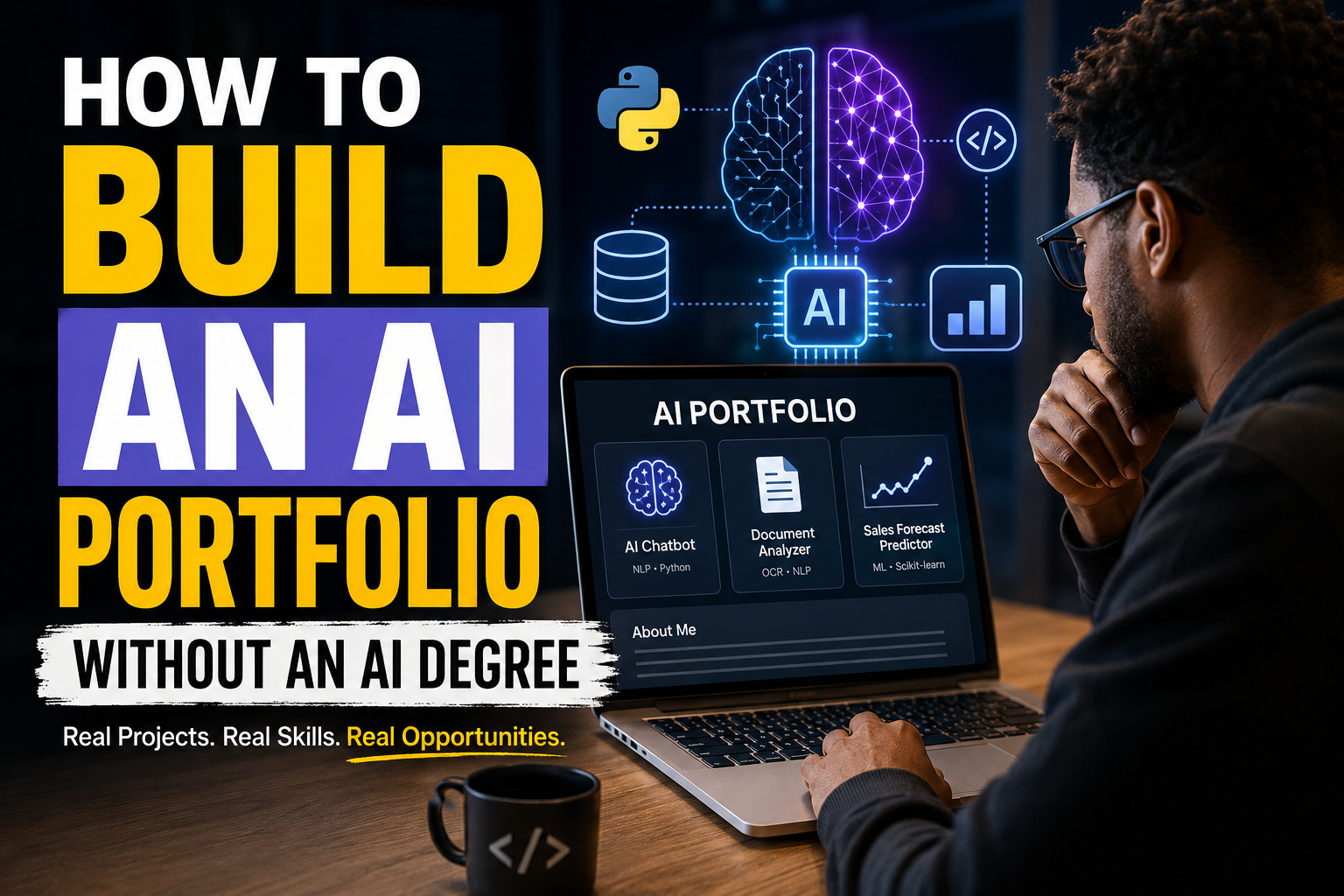
How to Build an AI Portfolio Without an AI Degree
You do not need an artificial intelligence degree to build a strong AI portfolio.
In fact, if you are trying to get your first AI job, freelance client, internship, or AI automation project, a portfolio can sometimes tell a potential employer more about what you can actually do than a list of certificates.
The challenge is knowing what to build, how to present it, and what employers or clients actually want to see.
You do not need to create the next ChatGPT. You do not need to train a billion-parameter model from scratch. And you certainly do not need ten complicated projects that nobody understands.
What you need is proof that you can identify a problem, choose an appropriate AI solution, build something useful, and explain how it works.
This guide shows you how to build an AI portfolio from scratch—even if you have no AI degree.
Do You Need an AI Degree to Work in AI?
No.
An AI degree can be valuable, particularly for research-heavy roles such as machine learning research, computer vision research, or advanced model development.
But the AI industry is much broader than research.
There are roles involving:
- AI automation
- AI application development
- AI agents
- Prompt engineering
- Retrieval-augmented generation (RAG)
- AI workflow design
- Data analysis
- AI product development
- Machine learning engineering
- AI consulting
- AI implementation
- AI content systems
Many of these jobs are evaluated heavily through practical skills and demonstrated projects.
That is why an AI portfolio matters.
Instead of saying:
“I know how AI works.”
You can show:
“I built an AI system that automatically sorts incoming customer documents, extracts important information, and sends the results to a CRM.”
The second statement is much stronger.
What Is an AI Portfolio?
An AI portfolio is a collection of projects that demonstrates your ability to use artificial intelligence to solve real problems.
Think of it as your practical evidence.
A good portfolio might contain:
- AI automation projects
- AI applications
- Machine learning projects
- AI agents
- Data projects
- RAG applications
- Chatbots
- AI-powered workflows
- Technical experiments
- Case studies
You don’t need all ten.
In fact, three excellent projects are usually better than fifteen unfinished ones.
Your goal should be to demonstrate different skills through a small number of meaningful projects.
What Should You Put in an AI Portfolio?
The biggest mistake beginners make is choosing projects because they look technically impressive.
Instead, choose projects that demonstrate usefulness.
For example, building another generic AI chatbot may not tell an employer much.
But building a chatbot that lets employees search company policies using natural language demonstrates several valuable skills.
It could involve:
Documents → embeddings → vector database → retrieval → AI model → response
Now you have a project that demonstrates a real business application.
Strong AI portfolio projects should answer three questions:
What problem does this solve?
How did you build it?
What result does it produce?
If your project can answer those questions clearly, it already becomes much more valuable.
Step 1: Choose the AI Career You Want
Before building your portfolio, decide what type of AI work you want to pursue.
You do not have to choose your entire career forever.
You simply need a direction for your first few projects.
If you want to become an AI automation specialist
Build projects involving:
- n8n
- Make
- APIs
- AI models
- CRM systems
- email automation
- document processing
- business workflows
If you want to become an AI application developer
Focus on:
- Python
- APIs
- databases
- AI model integration
- web applications
- authentication
- deployment
If you want to become a machine learning engineer
Build projects involving:
- Python
- pandas
- NumPy
- scikit-learn
- model training
- evaluation
- data preprocessing
- deployment
If you want to work with generative AI
Build:
- RAG applications
- AI assistants
- AI agents
- document analysis tools
- content-generation systems
- multimodal applications
Your portfolio should reflect the type of work you want someone to hire you for.
Step 2: Learn the Fundamentals
You don’t need to spend two years studying mathematics before building your first project.
But you should understand the fundamentals behind the tools you’re using.
At minimum, learn:
- What machine learning is
- What generative AI is
- How large language models work at a high level
- What APIs are
- How databases work
- Basic Python
- Basic Git and GitHub
- How AI models receive inputs and produce outputs
- What embeddings are
- What vector databases do
- Basic model evaluation
- AI limitations and hallucinations
You don’t need to become a mathematician.
However, avoid becoming someone who simply copies prompts from tutorials without understanding what the system is doing.
A strong portfolio demonstrates understanding, not just tool usage.
Step 3: Build Your First AI Project
Your first project should be relatively simple.
Don’t start by trying to build an autonomous AI employee.
Instead, solve one small problem.
For example:
AI Resume Analyzer
Build a simple application where a user uploads a resume and receives:
- extracted skills
- years of experience
- relevant job categories
- missing skills
- suggested improvements
A basic architecture could look like this:
Resume → Text extraction → AI model → Structured output → Web interface
This project can demonstrate:
- document processing
- AI APIs
- structured outputs
- prompt design
- basic application development
Most importantly, it gives you something you can demonstrate.
Step 4: Build a Real-World Business Project
Once you’ve completed your beginner project, build something connected to a real business problem.
This is where your portfolio starts becoming much more interesting.
Consider an AI invoice processing system.
Imagine an accounting firm receives hundreds of invoices every month.
Your system could:
- Accept an uploaded invoice.
- Extract the text.
- Identify the supplier.
- Extract the invoice number.
- Extract the date.
- Extract the total.
- Identify tax information.
- Categorize the expense.
- Store the information in a database.
- Flag uncertain information for human review.
Now you’re not simply demonstrating that you can “use AI.”
You’re demonstrating that you understand business automation.
That’s a much stronger portfolio story.
Step 5: Build a RAG Project
If you’re interested in modern AI applications, consider building a retrieval-augmented generation project.
RAG allows an AI system to retrieve information from a collection of documents before generating an answer.
For example, build an AI employee knowledge assistant.
Upload:
- company policies
- employee handbooks
- training documents
- product manuals
- FAQs
The employee can then ask:
“How many days of annual leave can I carry forward?”
The system searches the company’s documents and generates an answer based on the relevant information.
A simplified architecture looks like:
Documents → Chunking → Embeddings → Vector database → Retrieval → AI model → Answer
You don’t need to build every component yourself.
You can use existing tools to demonstrate that you understand how these systems fit together.
Step 6: Build an AI Automation Project
This is particularly useful if you want to work with businesses.
For example, create an automated lead qualification system.
Imagine a company receives inquiries through a website.
Your workflow could:
Website inquiry → AI analysis → Lead qualification → CRM → Email response → Sales notification
The AI could classify leads as:
- Hot
- Warm
- Cold
It could also extract:
- company name
- industry
- budget
- requested service
- urgency
Then the workflow could automatically send qualified leads to the company’s CRM.
This type of project demonstrates something employers and clients care about:
Can you connect AI to existing business processes?
Step 7: Create an AI Agent Project
Once you understand basic AI applications and automation, you can experiment with AI agents.
Don’t make the mistake of building an agent simply because the word “agent” is trending.
Give it a useful job.
For example:
AI Research Assistant
The agent could:
- Receive a research question.
- Search approved sources.
- Collect relevant information.
- Summarize findings.
- Identify supporting sources.
- Produce a structured report.
Your portfolio should clearly explain what the agent can and cannot do.
This is important because AI systems can make mistakes.
Showing that you understand those limitations actually makes your project look more professional.
Step 8: Put Your Projects on GitHub
GitHub should be one of the foundations of your AI portfolio.
But simply uploading code isn’t enough.
A repository should explain the project.
Your README should include:
Project name
AI Invoice Processing Assistant
Problem
Accounting teams spend significant time manually entering invoice information.
Solution
An AI-powered document processing workflow extracts invoice information and sends structured data to a database.
Technologies
- Python
- AI API
- OCR
- PostgreSQL
- n8n
How it works
Explain the workflow in simple language.
Demo
Include screenshots, a short video, or a live demo.
Results
Explain what the system successfully accomplishes.
Limitations
Explain where the system can fail.
That final section is often overlooked.
Don’t hide weaknesses.
Explain them.
It shows that you understand the technology rather than blindly promoting it.
Step 9: Create a Personal Portfolio Website
Your GitHub profile is useful, but don’t make recruiters dig through repositories to understand what you can do.
Create a simple portfolio website.
You don’t need an expensive design.
Your homepage should immediately answer:
Who are you?
What can you build?
What problems do you solve?
Where can someone see your work?
For example:
AI Automation Developer
I build practical AI systems that automate repetitive business processes, analyze documents, and connect AI models with existing business tools.
Then showcase your best projects.
Each project should have:
- Project title
- Problem
- Solution
- Technologies
- Screenshots
- Architecture
- Demo
- GitHub repository
- Results
Step 10: Show the Process, Not Just the Final Product
This is one of the easiest ways to make your portfolio stand out.
Don’t only show a screenshot of the finished application.
Show how you built it.
For example:
Before
An employee manually reads incoming invoices.
Problem
Manual processing takes time and creates opportunities for data-entry errors.
After
The AI system extracts invoice information and sends structured data into the accounting workflow.
Then explain the architecture.
This turns your portfolio into a collection of case studies, rather than a collection of random projects.
What Are the Best AI Portfolio Projects for Beginners?
Here are several project ideas you can build without an AI degree.
| Project | Skills Demonstrated |
|---|---|
| AI Resume Analyzer | LLMs, document processing |
| AI Invoice Extractor | OCR, structured data |
| Company Knowledge Bot | RAG, embeddings |
| AI Lead Qualifier | AI automation, APIs |
| Customer Support Assistant | LLMs, workflows |
| AI Meeting Summarizer | Speech-to-text, LLMs |
| AI Research Assistant | Agents, retrieval |
| AI Document Classifier | Classification, automation |
| AI Content Workflow | APIs, automation |
| AI Data Analyst | Python, data analysis, LLMs |
Pick projects that align with the job you want.
Don’t Build 20 Basic Chatbots
One of the biggest problems with beginner AI portfolios is repetition.
You might see:
- ChatGPT clone
- Customer chatbot
- PDF chatbot
- Another chatbot
- Another ChatGPT clone
After a while, these projects stop demonstrating new skills.
Instead, make each project prove something different.
For example:
Project 1: AI document processing
Project 2: RAG knowledge assistant
Project 3: AI business automation
Now your portfolio demonstrates three different capabilities.
That’s much stronger.
Do You Need to Know Python?
It depends on the type of AI career you’re pursuing.
If you want to become a machine learning engineer, Python is extremely important.
If you want to build AI applications, Python can be very useful.
If you’re focused primarily on AI automation, you can initially build many workflows using low-code tools while gradually learning Python.
However, learning basic Python will significantly expand what you can build.
Start with:
- variables
- functions
- loops
- lists
- dictionaries
- files
- APIs
- JSON
- error handling
Then learn how to work with AI APIs.
You don’t need to master everything before creating projects.
Learn → Build → Get stuck → Research → Improve.
That cycle is much more effective than endlessly watching tutorials.
How Many Projects Should an AI Portfolio Have?
Aim for three to five strong projects.
A good portfolio might contain:
Project 1 — Beginner
AI Resume Analyzer
Shows that you understand basic AI application development.
Project 2 — Intermediate
Company Knowledge Assistant
Shows RAG and document retrieval.
Project 3 — Business
AI Invoice Processing Workflow
Shows automation and practical business applications.
Project 4 — Advanced
AI Research Agent
Shows more sophisticated AI workflows.
You can stop there.
You don’t need fifty projects.
How to Make Your AI Portfolio Look Professional
Your portfolio doesn’t need to look expensive.
It needs to look clear.
For every project, include:
Problem → Approach → Technology → Demo → Result → Limitations
Use screenshots where appropriate.
If you have a working application, record a short demonstration.
A 60-second video showing your application processing a document can be more convincing than several paragraphs describing it.
Also make sure your GitHub repositories are organized.
Avoid repositories containing:
- broken code
- meaningless filenames
- missing instructions
- API keys
- copied tutorial projects
- unexplained code
Your portfolio is also a demonstration of how you work.
Can You Get an AI Job Without Experience?
Yes, but you need to replace some of the missing professional experience with evidence of practical ability.
That’s where projects become important.
Suppose two candidates apply for an entry-level AI automation position.
Candidate A writes:
“I completed several AI courses.”
Candidate B writes:
“I built an AI invoice processing workflow that extracts invoice information, validates required fields, stores structured records, and routes uncertain cases for human review.”
Candidate B has given the employer something concrete to investigate.
That doesn’t guarantee a job.
But it gives the conversation somewhere to start.
Use Real Problems Instead of Fake Projects
Here’s an important strategy.
Look around you.
What repetitive tasks do businesses perform every day?
Examples include:
- reading emails
- sorting documents
- entering data
- answering common questions
- summarizing meetings
- qualifying leads
- generating reports
- searching internal documents
- processing customer requests
Pick one.
Then ask:
Could AI make this process faster without removing necessary human oversight?
That’s where strong portfolio projects often begin.
Don’t Ignore Human Oversight
A professional AI portfolio shouldn’t pretend that AI is perfect.
In real businesses, AI outputs often need validation.
For example, an invoice system should not automatically approve every extracted amount without checks.
A better workflow might be:
AI extraction → confidence check → human review when necessary → final approval
This demonstrates an understanding of responsible AI implementation.
It also makes your project more realistic.
How to Write an AI Portfolio Project Description
Avoid writing:
“This is an innovative AI-powered solution using advanced artificial intelligence technologies.”
It sounds impressive but says almost nothing.
Instead, write:
“This application extracts key information from PDF invoices and converts it into structured data. It flags missing or uncertain fields for human review before the information is added to the accounting system.”
That’s clearer.
Your goal isn’t to impress people with complicated words.
Your goal is to make them understand what you built and why it matters.
What If You Have No Coding Experience?
You can still begin.
Start with no-code and low-code AI tools to understand workflows.
For example, you can create an automation that connects:
Form → AI model → Spreadsheet → Email
Then gradually replace parts of the workflow with code.
Eventually, you might progress to:
Python → API → Database → AI model → Web application
This approach allows you to learn by building rather than waiting until you feel “qualified.”
Your AI Portfolio Roadmap
If you’re starting from zero, here’s a simple roadmap.
Month 1: Foundations
Learn:
- AI fundamentals
- basic Python
- APIs
- GitHub
- JSON
- basic databases
Build one small AI application.
Month 2: Practical AI
Learn:
- document processing
- structured outputs
- embeddings
- RAG
- AI automation
Build two projects.
Month 3: Portfolio
Create:
- personal website
- GitHub repositories
- project demonstrations
- case studies
- resume links
Then begin applying for jobs, internships, freelance projects, or client work.
You can continue improving the portfolio while applying.
You don’t have to wait until everything is perfect.
How to Stand Out Without an AI Degree
The strongest strategy is to become specific.
Instead of saying:
“I am interested in AI.”
Say:
“I build AI document-processing and automation systems for accounting and professional-service businesses.”
That immediately communicates your value.
You can even specialize your portfolio around an industry.
For example:
AI for Accounting
Build:
- invoice processing
- receipt classification
- tax document sorting
- financial document search
- client email classification
AI for Legal
Build:
- contract summarization
- document search
- clause extraction
- legal intake automation
AI for Sales
Build:
- lead qualification
- CRM enrichment
- meeting summaries
- personalized outreach workflows
This makes your portfolio easier for businesses to understand.
The Biggest Mistake to Avoid
Don’t spend six months collecting certificates before building anything.
Courses are useful.
Certifications can be useful.
But neither replaces practical evidence.
If you’ve spent three months learning AI, start building.
Your first project will probably be imperfect.
That’s normal.
The second will be better.
By the third, you’ll understand far more about AI development than you did when you started.
Final Thoughts
Building an AI portfolio without an AI degree is absolutely possible.
You don’t need to prove that you know everything about artificial intelligence.
You need to demonstrate that you can learn, build, solve problems, and explain your work.
Start with one useful project.
Then build another that demonstrates a different skill.
Put the code on GitHub. Create demonstrations. Explain the problem you solved. Show the architecture. Discuss limitations. And whenever possible, connect your projects to real business problems.
A portfolio built this way can become more than a collection of projects.
It can become your proof of ability.
And when you’re competing with candidates who have impressive academic credentials, that proof can give you something powerful to show:
“I may not have an AI degree, but here is what I can actually build.”