Is Dubbing AI Safe?
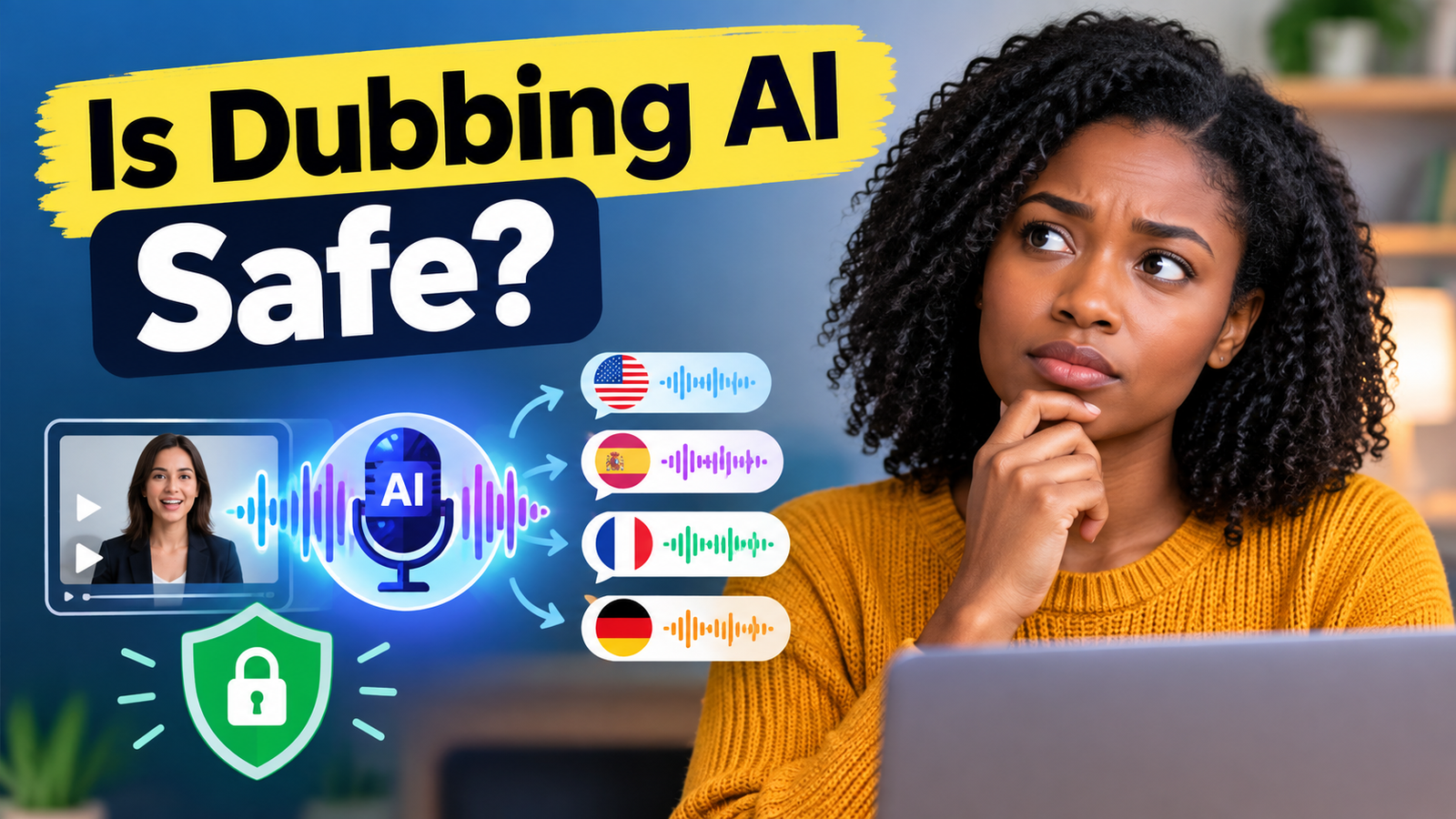
Is Dubbing AI Safe? What You Should Know Before Using AI Dubbing Tools
Yes, AI dubbing can be safe, but it depends heavily on which tool you use, what content you upload, whose voice is being used, and how the final audio is used.
AI dubbing has become popular because it can translate videos into different languages while keeping the speaker’s voice, tone, and timing relatively natural. But behind that convenience are important questions about privacy, voice cloning, copyright, consent, and data security.
The good news is that you don’t necessarily need to avoid AI dubbing. You simply need to understand the risks and use the technology responsibly.
What Is AI Dubbing?
AI dubbing uses artificial intelligence to replace the original spoken language in a video with another language.
For example, imagine you create a YouTube video in English.
An AI dubbing tool could:
- Transcribe your speech.
- Translate the transcript into French.
- Generate French speech.
- Match the new speech with the timing of your video.
- In some cases, reproduce characteristics of your original voice.
Instead of hiring a separate voice actor for every language, one video can potentially be turned into several language versions.
This is particularly useful for YouTubers, online educators, businesses, marketers, and media companies.
But the technology becomes more complicated when voice cloning is involved.
Is AI Dubbing Actually Safe?
There isn’t a simple yes-or-no answer.
AI dubbing itself isn’t inherently dangerous. The bigger risks come from how AI dubbing services handle your uploaded material and how voice-cloning technology is used.
The U.S. Federal Trade Commission has specifically warned about risks associated with AI voice cloning, including fraud, impersonation, misuse of biometric information, and unauthorized use of people’s voices.
So think of AI dubbing as a tool.
The tool can be used safely, but you need to control what you give it and what you do with the result.
1. Your Voice Is Personal Data
This is probably the biggest issue people overlook.
When you upload your voice to an AI dubbing platform, you’re not simply uploading an ordinary audio file.
Your voice contains characteristics that can potentially be used to create a model capable of producing speech that sounds like you.
For example, ElevenLabs explains that its services can process voice recordings to create voice models and that voice data may be considered biometric data under applicable laws depending on where a person lives and how the data is used.
That doesn’t automatically mean the service is unsafe.
It means you should treat your voice as valuable personal information.
Before uploading recordings, check:
- What happens to uploaded audio?
- Is it stored?
- How long is it stored?
- Can you delete it?
- Can it be used to improve AI models?
- Can third parties access it?
- Can your voice model be shared?
- Can you opt out of training?
These questions matter even more if you’re dubbing videos for clients.
2. Check Whether Your Data Is Used for AI Training
This is one of the most important things to check before choosing an AI dubbing service.
Some AI companies allow submitted data to be used to improve their models, while others provide controls allowing users to opt out.
For example, ElevenLabs currently says certain user data may be used to improve its audio models, while users can disable the relevant data-use setting. It also says Enterprise customers’ data is not used for training by default, except where necessary to provide the service.
That distinction can be extremely important.
Imagine you’re dubbing:
“Our company generated $5 million in revenue last year.”
You probably don’t want confidential business information being unnecessarily used to improve a public AI model.
For sensitive business projects, look for:
No-training options + enterprise privacy controls + clear deletion policies.
3. Is Voice Cloning Legal?
This is where things get particularly important.
If you’re dubbing your own voice, the situation is much simpler.
If you’re dubbing someone else’s voice, you need to consider whether you have the appropriate rights and authorization.
Don’t simply download a celebrity’s interview, upload the audio to an AI tool and create new statements in their voice.
That could create serious legal and ethical problems.
AI voice cloning has already raised concerns around impersonation and fraud. The FTC has highlighted the possibility of cloned voices being used to deceive people and exploit creative professionals.
Some platforms have therefore introduced restrictions.
For example, ElevenLabs says its Professional Voice Clone feature requires verification and only permits users to create a Professional Voice Clone of their own voice through that process.
The safest rule is simple:
Don’t clone another person’s voice unless you have the necessary authorization and the platform explicitly allows that use.
4. Be Careful With Client Videos
This becomes particularly important if you’re running an AI content or dubbing business.
Suppose a client sends you a corporate training video containing:
- employee interviews
- customer information
- financial information
- internal presentations
- confidential product information
- personal information
Uploading the entire video to a random AI dubbing website could expose information that your client never intended to leave their systems.
Before processing client material, establish:
What information is contained in the video?
Then check:
Where will the data go?
And:
What does the AI provider do with it?
For highly confidential projects, consider providers that offer stronger business privacy controls or processing arrangements appropriate for your client’s requirements.
5. Copyright Still Matters
AI dubbing doesn’t eliminate copyright.
Suppose you download someone else’s YouTube video and translate the entire video into Spanish using AI.
The fact that you generated the Spanish voice with AI doesn’t mean you own the underlying video.
The original creator may still own rights to:
- the video
- the script
- music
- graphics
- performances
- recordings
AI-generated dubbing doesn’t automatically give you permission to redistribute someone else’s copyrighted material.
The safest approach is to dub:
content you created, content you licensed, or content you have permission to modify.
6. AI Dubbing Can Also Create Misinformation
There’s another risk that’s easy to overlook.
AI dubbing can make it appear that someone said something in another language when they didn’t actually say those exact words.
Imagine a politician gives a speech in English.
Someone creates an AI-dubbed version in another language containing completely different statements.
To viewers unfamiliar with the original language, it could appear authentic.
That’s one reason AI voice cloning and synthetic audio have attracted attention from regulators and researchers. The FTC has emphasized risks involving deception, fraud and impersonation.
For responsible creators, transparency matters.
If a video has been significantly altered using AI voice technology, consider clearly identifying it as AI-generated or AI-dubbed where appropriate.
7. Is ElevenLabs Safe for AI Dubbing?
ElevenLabs is one example of a major AI audio platform that has invested heavily in safety controls.
Its current safety documentation describes measures including voice verification, monitoring, restrictions on high-risk voices, content traceability and tools for detecting AI-generated audio.
Its current prohibited-use policy also restricts unauthorized or deceptive impersonation, including intentionally replicating another person’s voice without consent or legal rights.
However, “safe” doesn’t mean “risk-free.”
You should still read the current privacy and terms documentation before uploading sensitive material.
This is especially important if you’re using AI dubbing professionally.
8. How to Make AI Dubbing Safer
You don’t need to stop using AI dubbing.
Instead, follow these precautions.
Before uploading your video:
1. Use reputable platforms
Avoid unknown websites promising unlimited free voice cloning.
2. Read the privacy policy
Look specifically for information about:
- audio storage
- AI training
- retention
- deletion
- third-party sharing
3. Don’t upload unnecessary information
If you only need the audio, you may not need to upload an entire video containing sensitive information.
4. Get permission
If another person’s voice is involved, obtain appropriate authorization.
5. Protect confidential client information
Don’t upload sensitive business material to consumer-grade tools without checking the provider’s data practices.
6. Check commercial rights
If you’re monetizing the dubbed content, verify that the AI service permits commercial use.
7. Review the translation
AI can mistranslate jokes, technical terminology, names and sensitive statements.
8. Disclose AI use when appropriate
Don’t use AI dubbing to deliberately trick viewers into believing someone said something they didn’t.
Is AI Dubbing Safe for YouTube?
For most creators, yes, AI dubbing can be a practical and relatively safe way to expand a YouTube channel internationally, provided you use your own content and voice or properly authorized voices.
For example, you could create:
English video → Spanish version → French version → German version → Portuguese version
This can potentially let one piece of content reach multiple audiences.
The bigger danger isn’t the dubbing itself.
It’s uploading sensitive material, cloning unauthorized voices, violating copyright, or misleading viewers about what is real.
Is AI Dubbing Safe for Monetized Videos?
Generally, AI-generated or AI-assisted content isn’t automatically unsafe simply because AI was used.
However, monetization depends on the platform’s current policies and the nature of the content.
The bigger question is whether your video provides genuine value and whether you have the necessary rights to the underlying material and audio.
For example:
Safer approach:
You create an educational video → AI translates and dubs it → you review it → publish different language versions.
Riskier approach:
You download another creator’s video → clone their voice → translate it → upload it to your channel as your own.
The second approach creates substantially more copyright, impersonation and platform-policy risks.
The Biggest AI Dubbing Mistakes to Avoid
Here are seven mistakes I would avoid:
❌ Cloning someone’s voice without authorization
❌ Uploading confidential client information
❌ Assuming “AI-generated” means copyright-free
❌ Using a random free AI voice website for sensitive projects
❌ Ignoring the platform’s data-training settings
❌ Publishing inaccurate AI translations without checking them
❌ Using an AI clone to make someone appear to say something they never said
A Simple AI Dubbing Safety Checklist
Before clicking Generate, ask:
| Question | Safe approach |
|---|---|
| Is it my content? | Yes, or I have permission |
| Is it my voice? | Yes, or I have authorization |
| Does the platform train on uploads? | I understand and control the setting |
| Is the material confidential? | Use appropriate business/privacy controls |
| Can I delete my recordings? | Check the provider’s policy |
| Can I commercially use the output? | Confirm the terms |
| Is the translation accurate? | Human review |
| Could viewers be misled? | Clearly disclose AI use where appropriate |
Final Verdict: Is Dubbing AI Safe?
Yes—but don’t confuse convenience with privacy.
AI dubbing is generally safe when you use reputable services, your own content, authorized voices, appropriate privacy settings and careful human review.
The biggest risks are not simply that “AI will steal your voice.”
The more realistic concerns are unauthorized voice cloning, data retention, confidential information, copyright violations, impersonation and misleading synthetic audio.
The FTC has specifically identified voice cloning as a technology that can create both legitimate benefits and significant risks, particularly around fraud, impersonation and misuse of voice data.
So the best rule to remember is:
Use AI dubbing as a production tool—not as a shortcut around consent, copyright or privacy.
If you’re a YouTuber, blogger, agency owner or business using AI dubbing, the safest workflow is to own or license the content, use authorized voices, minimize sensitive uploads, check the provider’s data policy, and review every translated version before publishing.