
How to Use AI Without Losing Your Freelance Clients’ Trust
Tags: ai, AI automation, AI business, AI ethics, AI for freelancers, AI for work, AI freelancing, AI productivity, AI risks, ai tools, AI writing, artificial intelligence, chatgpt, client relationships, client trust, freelance business, freelance career, freelance clients, freelance clients trust, freelance tips, freelancing, future of freelancing, human AI collaboration, making money with AI, online income, responsible AI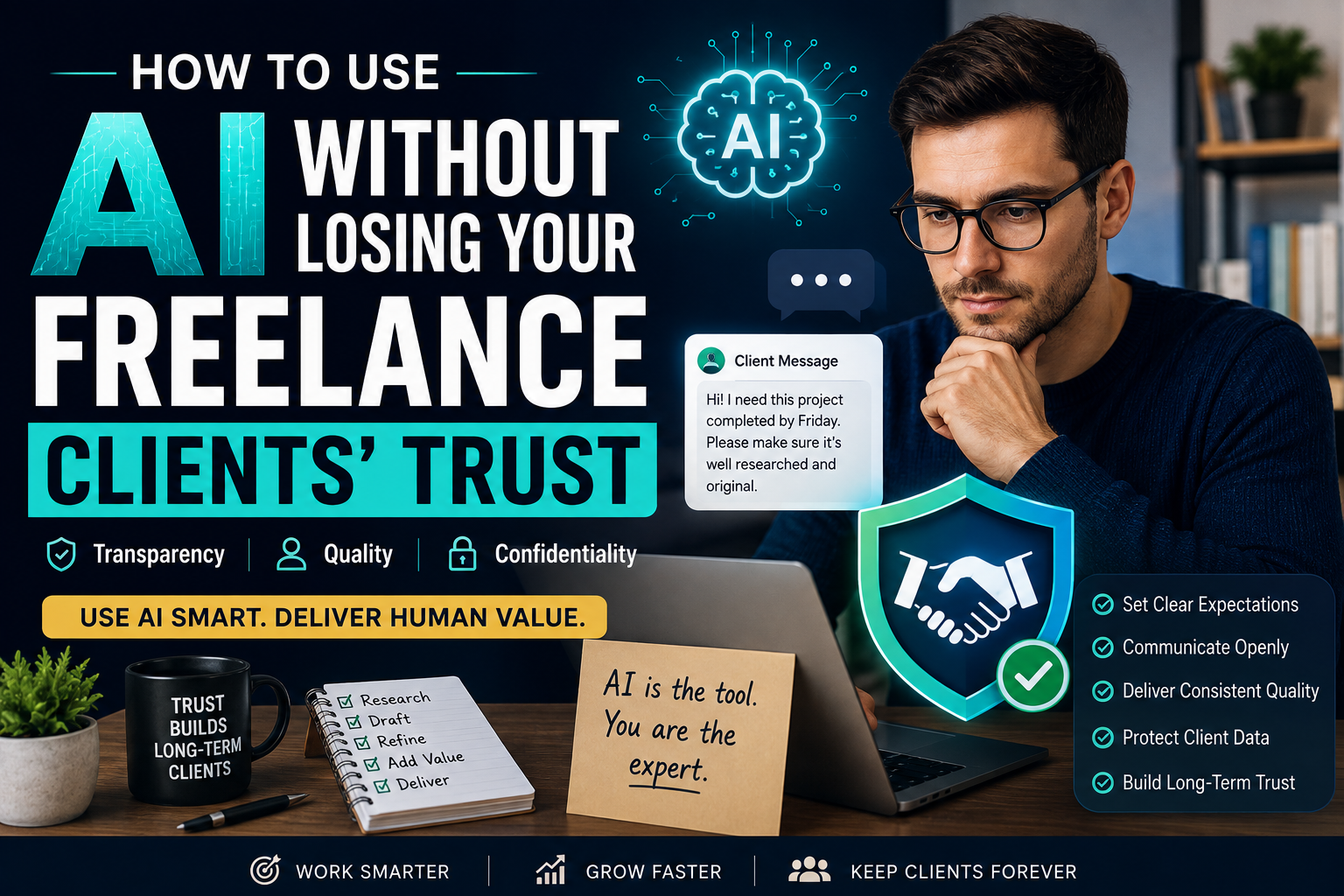
How to Use AI Without Losing Your Freelance Clients’ Trust
AI has changed freelancing in ways I could not have imagined a few years ago.
Today, I can use artificial intelligence to brainstorm ideas, research topics, analyze information, improve writing, organize data, create outlines, automate repetitive tasks, and even speed up parts of my client workflow.
That sounds like a win—and it can be.
But there is another side of the AI revolution that every freelancer needs to think about:
Trust.
A client may not care that I used AI to save two hours on a task. What they care about is whether the final work is accurate, original, secure, useful, and genuinely suited to their business.
That is why I don’t believe the goal should be to hide AI from clients.
The better goal is to learn how to use AI without losing your freelance clients’ trust.
This matters even more in 2026 because AI use is becoming normal across freelance work. Upwork’s 2026 Future Workforce Index found that skilled freelancing increased substantially among U.S. knowledge workers, while more complex AI-augmented professional work is becoming more valuable. The same research points toward a future where combining AI skills with human judgment, expertise, and accountability is increasingly important.
So the question isn’t really:
“Should freelancers use AI?”
For many freelancers, the answer is already yes.
The better question is:
“How can I use AI to become a better freelancer without making my clients feel like they’re paying me for work a machine could have produced?”
Here’s how I approach it.
Why Client Trust Matters More Than Ever
Freelancing has always been built around trust.
When someone hires me, they aren’t simply buying words, designs, code, videos, spreadsheets, or marketing materials.
They’re buying my judgment.
They’re trusting me to understand their instructions, identify problems, make decisions, meet deadlines, protect their information, and deliver something that helps them achieve a specific outcome.
AI doesn’t eliminate that responsibility.
If anything, it makes it more important.
Research from Upwork found that clients place considerably more trust in work produced through human-AI collaboration than in AI-only outputs. In its research, 66% of clients reported high trust in outputs from freelancers using AI tools, compared with only 26% trusting work delivered by AI alone.
That’s a powerful distinction.
Clients aren’t necessarily afraid of AI. They’re afraid of being abandoned to AI.
They don’t want to pay a freelancer $500 only to receive something that looks like it came straight out of a chatbot.
They want someone who can use technology while still taking responsibility for the result.
And that’s where freelancers can differentiate themselves.
1. Use AI as an Assistant, Not Your Replacement
This is probably my most important rule.
I don’t want AI to become my freelancer.
I want AI to become my assistant.
There’s a big difference.
For example, if I’m writing an article for a client, I might use AI to:
- brainstorm angles
- organize research
- create an initial outline
- identify questions readers may have
- simplify complicated concepts
- suggest alternative headlines
- help me identify gaps in my draft
But I shouldn’t simply copy the output, put my name on it, and send it to the client.
My expertise still has to drive the work.
I need to ask:
Is this accurate?
Does it actually answer the client’s objective?
Does it sound appropriate for their audience?
Are the claims supported?
Does it match their brand voice?
What did AI get wrong?
That final layer of judgment is where my value lives.
2. Don’t Sell AI Output—Sell Expertise
This is where I think many freelancers are going wrong.
Imagine two freelancers.
Freelancer A says:
“I use AI to write articles in 10 minutes.”
Freelancer B says:
“I use modern AI tools to accelerate research and production, but I personally handle strategy, fact-checking, editing, positioning, and final quality control.”
Which freelancer would you trust more?
For me, it’s obvious.
The second freelancer is selling expertise, not access to a chatbot.
That’s the direction I would take.
Instead of saying:
“AI helped me produce this.”
I would communicate the actual value:
“I use AI to improve efficiency while maintaining human research, editing, strategic thinking, and quality control.”
That’s a much stronger proposition.
3. Be Transparent About AI When It Matters
One of the biggest questions freelancers have is:
Should I tell my clients that I use AI?
My answer is:
Don’t automatically hide it, but don’t make every minor AI-assisted task sound like a major event either.
The right approach depends on the project, the client’s expectations, the contract, and how significantly AI contributes to the deliverable.
A 2026 study specifically examining AI disclosure in freelance work found an important mismatch: freelancers often disclose AI use only when asked, while clients tend to prefer proactive disclosure. The researchers also found that unclear client policies can cause freelancers to misunderstand what clients expect.
That tells me something important:
Silence isn’t always the safest strategy.
If AI is substantially involved in producing the deliverable, I’d rather establish expectations early.
For example:
“I use AI-assisted tools for research, brainstorming, and certain production tasks, but I personally review, fact-check, edit, and approve all final deliverables. If you have specific requirements regarding AI use, I’m happy to follow them.”
That’s transparent without unnecessarily undermining your value.
4. Always Check the Client’s AI Policy
Before using AI on client work, I would check:
- the contract
- project brief
- platform rules
- NDA
- company policies
- data-handling requirements
- intellectual-property requirements
- client instructions
Some clients may allow AI for brainstorming but prohibit it for final deliverables.
Others may require disclosure.
Some businesses may prohibit uploading confidential material to external AI systems.
And others may have their own approved AI tools.
So never assume:
“Everyone is using AI, therefore my client won’t care.”
That’s dangerous.
Your client gets to decide what happens to their information and what standards apply to their project.
5. Never Put Confidential Client Information Into AI Carelessly
This is one of the biggest risks to consider when using AI as a freelancer.
Suppose a client sends me:
- customer information
- financial records
- unpublished product information
- passwords
- proprietary research
- internal strategy documents
- private contracts
- personal information
I shouldn’t automatically paste that information into an AI tool just because I want help analyzing it.
That’s where efficiency can turn into a serious trust problem.
Before using AI with sensitive information, I need to understand the tool’s data practices, the client’s requirements, and any contractual restrictions.
If I don’t need the identifying information to complete the task, I can often remove or anonymize it.
For example, instead of giving an AI system an actual customer’s name, phone number, and account details, I might use:
Customer A
Customer B
Customer C
The general principle is simple:
Don’t sacrifice client confidentiality for convenience.
This is especially important because concerns around AI security and privacy remain significant. A 2026 Adobe survey reported that data privacy and security were among organizations’ major concerns around AI use, alongside worries about AI-generated errors.
6. Fact-Check Everything Important
AI can be incredibly useful.
It can also be confidently wrong.
That’s one of the biggest reasons I don’t treat AI output as finished work.
If I’m working on something involving:
- statistics
- legal information
- financial information
- medical information
- technical specifications
- company information
- current events
- research
- citations
I need to verify it.
I don’t want to tell a client:
“The AI said this was correct.”
That’s not professional accountability.
The client hired me.
Therefore, if AI makes a mistake, I own the mistake.
Global research from KPMG and the University of Melbourne found that although AI adoption is widespread, trust remains a major challenge; only 46% of respondents globally said they were willing to trust AI systems, while many reported using AI output without evaluating its accuracy.
That reinforces a rule I want to follow:
AI can generate the information. I am responsible for deciding whether the information deserves to be used.
7. Add Something AI Can’t Easily Replicate

If I’m using AI, I need to make sure I’m adding human value.
That could be:
- personal experience
- original research
- interviews
- strategic thinking
- industry knowledge
- storytelling
- creativity
- client-specific recommendations
- original analysis
- judgment
- editing
- relationship management
This is especially important for writers.
If I give a client a generic 2,000-word AI article, there’s little reason for them to keep paying me.
But if I give them:
research + strategy + original insights + AI-assisted efficiency + expert editing + SEO + brand understanding
I’m offering something much harder to replace.
This is also where freelancing is heading.
Upwork’s 2026 research describes a growing premium for complex AI-augmented work where freelancers combine AI fluency with domain expertise, judgment, workflow design, and business outcomes.
That’s the opportunity.
8. Don’t Pretend AI Did Nothing
There’s another mistake I would avoid: pretending that every piece of work was produced entirely manually when it wasn’t.
You don’t necessarily need to announce:
“AI wrote 72% of this article.”
That can create unnecessary confusion.
Instead, establish an appropriate level of transparency.
For example:
“I use AI-assisted tools during parts of my research and production process, but every deliverable is reviewed and finalized by me.”
That’s honest.
And if a client specifically asks:
“Did you use AI?”
Answer truthfully.
Trust is difficult to build and incredibly easy to destroy.
9. Let Clients See Your Quality-Control Process
One of the easiest ways to build trust in AI-assisted freelancing is to explain what happens after AI generates something.
Don’t just say:
“I use AI.”
Explain:
“I use AI for initial research and brainstorming. I then verify important information, rewrite the material, adapt it to your brand voice, check for inconsistencies, and perform a final human review before delivery.”
Now the client understands that AI isn’t the final decision-maker.
You are.
That distinction can completely change how clients perceive your workflow.
10. Don’t Charge for AI Speed in a Misleading Way
This one requires some thought.
Suppose AI helps me complete something in two hours that previously took five.
Does that automatically mean I should charge only for two hours?
Not necessarily.
Freelancers aren’t simply selling minutes.
They’re selling:
- expertise
- outcomes
- reliability
- experience
- communication
- problem-solving
- responsibility
- quality
However, I also wouldn’t intentionally inflate hours to make it appear that I spent five hours manually doing something that took two.
Instead, I’d move toward value-based pricing or project-based pricing where appropriate.
The client is paying for the agreed outcome—not necessarily for how slowly I can produce it.
AI can make me more efficient.
That’s a benefit, not something I should be ashamed of.
Are There Any Risks to Using AI?
Yes.
And pretending otherwise would be irresponsible.
The biggest risks for freelancers include:
1. Incorrect information
AI can generate false or outdated information.
2. Confidentiality problems
Uploading private client information to an inappropriate tool can create security and contractual concerns.
3. Intellectual-property concerns
Depending on the work and jurisdiction, AI-assisted content can raise questions around ownership, licensing, originality, or third-party material.
4. Loss of originality
If I rely too heavily on AI, my work can become generic.
5. Client-policy violations
A client may prohibit or restrict AI use.
6. Quality problems
AI-generated work may require significant editing before it becomes professional.
7. Reputation damage
One bad deliverable can hurt a freelancer’s reputation much more than AI saves time.
That’s why responsible AI use isn’t about avoiding technology.
It’s about managing the risks.
How Can We Build Trust in AI?
For freelancers, I don’t think we build trust by convincing clients that AI is perfect.
We build trust by showing that humans remain accountable.
That means:
Transparency
Tell clients what matters.
Verification
Check important AI-generated information.
Human oversight
Don’t blindly send AI output to clients.
Privacy
Protect confidential information.
Consistency
Deliver the same quality regardless of which tools you use.
Accountability
Take responsibility for mistakes.
Communication
Ask clients about their AI preferences before assumptions create problems.
In other words:
Don’t ask your clients to trust AI. Give them reasons to trust you using AI responsibly.
That’s a much stronger approach.
Is Freelancing Still Worth It in 2026?
Yes—but I think freelancing is becoming more competitive.
The old model of simply selling basic execution is under pressure.
If a client can generate a basic article, social post, simple design, translation, or research summary with AI, they have less incentive to pay someone solely for that basic output.
But that doesn’t mean freelancing is dead.
It means the value is moving upward.
Upwork’s 2026 Future Workforce Index found that skilled freelancing had increased among U.S. knowledge workers, while complex AI-augmented professional work was gaining value.
That’s the lesson I take from the current market.
Don’t compete with AI on the things AI is exceptionally good at.
Use AI to become better at the things clients still need humans to do.
How to Attract Clients as a Freelancer in the AI Era
The answer isn’t simply:
“I’m good at using AI.”
Thousands of freelancers can say that.
Instead, position yourself around a business outcome.
Instead of:
“I’m an AI writer.”
Try:
“I help SaaS companies turn complex topics into SEO content that attracts qualified traffic.”
Instead of:
“I use AI for social media.”
Try:
“I help small businesses create consistent social content without spending hours every week managing it.”
Instead of:
“I use AI for data analysis.”
Try:
“I help businesses turn messy spreadsheets into clear reports and dashboards.”
See the difference?
You’re no longer selling the tool.
You’re selling the result.
AI simply becomes part of your delivery system.
How to Use AI Without Losing Your Freelance Clients’ Trust Free
You don’t need an expensive AI system to start doing this responsibly.
You can begin with a simple workflow:
Step 1: Understand the client
Before opening an AI tool, understand what the client actually wants.
Step 2: Check AI restrictions
Look at the contract and ask about AI policies when necessary.
Step 3: Remove sensitive information
Never casually upload confidential information.
Step 4: Use AI for assistance
Use it for brainstorming, research support, organization, drafts, analysis, or repetitive tasks where appropriate.
Step 5: Apply your expertise
Rewrite, improve, analyze, customize, and make decisions.
Step 6: Verify
Fact-check important information.
Step 7: Perform quality control
Check the final work against the client’s instructions.
Step 8: Communicate honestly
If disclosure is required or appropriate, disclose your AI use.
Step 9: Deliver the result
The client should receive professional work—not a raw AI output.
You can do all of that with the AI tools you already have access to.
The expensive part isn’t the software.
The valuable part is your judgment.
My Final Take: AI Should Make Me a Better Freelancer, Not a Less Valuable One
I don’t think the future of freelancing belongs to people who refuse to use AI.
But I also don’t think it belongs to people who hand their entire business over to AI.
I think the strongest freelancers will sit somewhere in the middle.
They’ll use AI to:
- research faster
- automate repetitive work
- generate ideas
- analyze information
- improve productivity
- experiment with new services
- reduce unnecessary manual work
But they’ll continue to provide what clients actually pay for:
judgment, expertise, creativity, communication, accountability, strategy, and results.
That’s the model I would build my freelance career around.
The goal isn’t to convince clients that “AI doesn’t do my work.”
The goal is to show them:
“AI helps me work more efficiently, but I’m still the person responsible for the quality, accuracy, strategy, and outcome.”
That is how I would use AI without losing my freelance clients’ trust.
And as AI becomes even more powerful over the next five years, I believe that distinction will become more important—not less.
The freelancer who simply produces AI output will increasingly compete on price.
The freelancer who knows how to combine AI with expertise to solve a client’s real problem can compete on value.
That’s the future of freelancing I want to prepare for.